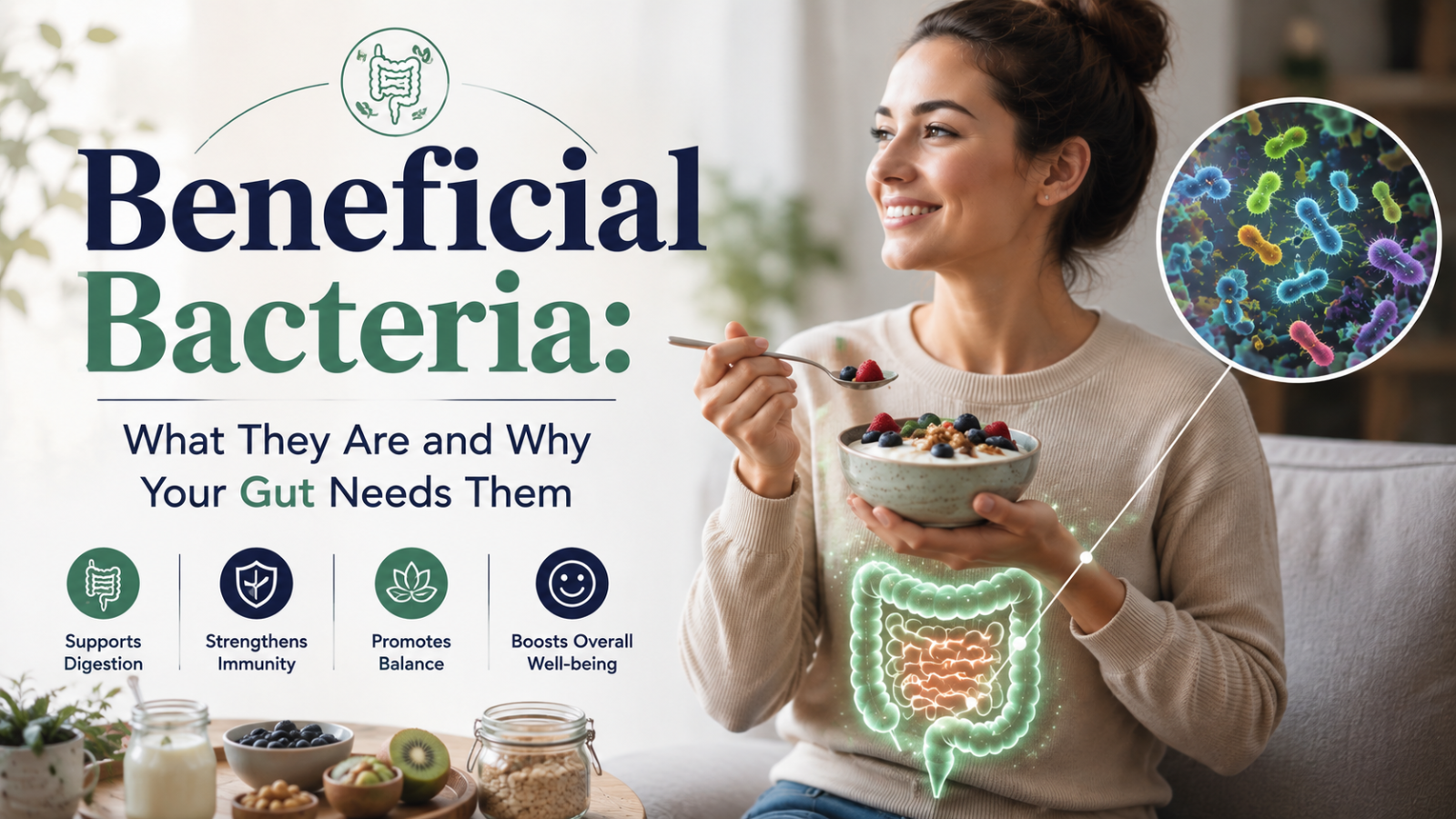
Beneficial bacteria are an important part of the living ecosystem inside your digestive tract, helping your gut interact with food and maintain a diverse microbial community. Your body isn’t meant to be completely free of bacteria; many microorganisms are a normal and valuable part of human health. Use the Copy Button to save the most useful ideas from this guide and return to them when you want simple gut-health reminders.
The science can sound complicated at first. However, the basic idea is straightforward: your body lives alongside trillions of microorganisms, and daily habits can influence the environment where many of them live.
Quick Answer: What Are Beneficial Bacteria?
Beneficial bacteria are microorganisms that can perform useful functions in the body, particularly within the digestive tract. They are part of the larger gut microbiome, where different microorganisms interact with food, the intestinal environment, and one another.
Some beneficial bacteria help break down dietary compounds that humans cannot fully digest. Others participate in processes that produce substances used within the gut.
However, scientists do not divide every bacterium into simple “good” and “bad” categories. The microbiome is a complex ecosystem, and the effects of a microorganism can depend on its species, location, and surrounding environment.
What Are Beneficial Bacteria in the Gut?
Beneficial bacteria naturally live in and on the human body. Large communities of microorganisms are found in the digestive tract, especially in the large intestine.
The term gut microbiome refers to the collection of microorganisms and their genetic material in the digestive system. Bacteria make up an important part of this larger community.
These microorganisms don’t all perform the same jobs.
Some interact with dietary fiber. Others compete for space and resources in the gut. Meanwhile, certain bacteria participate in metabolic processes that researchers continue to study.
This variety is one reason microbiome science is so interesting.
A healthy gut isn’t about having one perfect type of bacterium. Instead, researchers often focus on the overall community and the ways different microorganisms interact.
How Beneficial Bacteria Support Digestion
Beneficial bacteria can interact with food after it passes through the upper digestive system.
Humans do not completely digest every compound found in food. Certain carbohydrates and fibers can reach the large intestine, where microorganisms may interact with them.
As a result, bacteria can participate in processes that affect the gut environment.
Fiber plays an important role here.
For example, foods such as beans, oats, vegetables, fruits, nuts, and seeds contain different types of dietary fiber. These foods don’t provide identical nutrients, so variety can expose the gut microbiome to a wider range of compounds.
One meal won’t transform your microbiome.
Instead, consistent eating patterns can influence the environment in your digestive tract over time.
That’s good news because supporting your gut usually doesn’t require an extreme diet.
Why Beneficial Bacteria Matter for Gut Health
Beneficial bacteria matter because the gut is an active ecosystem rather than an empty tube that simply processes food.
Microorganisms interact with the materials that reach the digestive tract. They also interact with one another.
Research suggests that the composition and activity of the gut microbiome may be connected with several aspects of human health. However, researchers are still learning exactly how these relationships work.
That distinction matters.
A connection between certain bacteria and a health outcome does not always prove that the bacteria caused the outcome.
Therefore, it is wise to be cautious about products that promise to “fix” your microbiome.
Gut health is influenced by many factors, including diet, sleep, physical activity, medications, stress, and individual biology.
Beneficial bacteria are part of that bigger picture.
Beneficial Bacteria and Dietary Fiber
One of the most practical ways to think about beneficial bacteria is through food.
Dietary fiber can provide material that certain gut microorganisms use. Different fiber-rich foods contain different types of compounds, which is why dietary variety can be useful.
Consider a typical day.
Oatmeal at breakfast provides different components than lentil soup at lunch. An apple snack adds something else, while vegetables at dinner contribute additional variety.
You don’t need to turn every meal into a nutrition project.
I find that adding one extra plant food is often easier than completely redesigning a plate. Toss berries onto oatmeal, add beans to a salad, or serve vegetables beside a familiar dinner.
Those small habits can become part of a more varied eating pattern.
Foods That May Support Beneficial Bacteria
No single food can create a perfect microbiome.
However, a wide range of plant foods can support an overall eating pattern associated with gut health.
Beans and Lentils
Beans and lentils contain dietary fiber and other nutrients. They are also versatile enough to use in soups, salads, grain bowls, and everyday meals.
If you rarely eat legumes, start with a modest portion.
A gradual increase may feel more comfortable than making a dramatic change overnight.
Whole Grains
Oats, barley, brown rice, and other whole grains can add variety to your meals.
Instead of eating the same grain every day, rotate your choices when possible.
Fruits and Vegetables
Different colors often represent different naturally occurring compounds.
Try mixing familiar choices throughout the week. Apples, berries, leafy greens, broccoli, carrots, and sweet potatoes can all add variety.
You don’t need a refrigerator filled with unusual ingredients.
Simple foods work just fine.
Nuts and Seeds
Nuts and seeds can provide fiber along with other nutrients.
Sprinkle seeds over yogurt or oatmeal, or keep a small portion of nuts available for an easy snack.
Can Fermented Foods Add Beneficial Bacteria?
Some fermented foods contain live microorganisms.
Yogurt with live cultures and kefir are common examples. Certain fermented vegetables may also contain live microorganisms, although the final product depends on how it was made and processed.
Therefore, not every fermented food provides the same bacterial cultures.
Reading the label can help.
Heat treatment and manufacturing methods may affect whether live microorganisms remain in a finished product.
It’s also important not to assume that every food containing bacteria will have the same effect as a clinically studied probiotic.
Food and supplements serve different purposes.
Still, fermented foods can add flavor and variety to an eating pattern when you enjoy them.
Beneficial Bacteria vs. Probiotics
These terms are related, but they are not interchangeable.
Beneficial bacteria is a broad description for bacteria that can perform useful functions.
Probiotics are more specific. According to the commonly accepted definition, probiotics are live microorganisms that provide a health benefit when consumed in adequate amounts.
This distinction is useful when reading product labels.
A food can contain bacteria without qualifying as a probiotic. Likewise, not every probiotic product has evidence for every health claim on its packaging.
Specific strains matter.
Research on one strain should not automatically be applied to another. As a result, it helps to look beyond general words such as “gut support” or “microbiome balance.”
What Can Affect Beneficial Bacteria?
Your microbial community can change over time.
Food is one influence, but it isn’t the only one.
Several factors may affect beneficial bacteria and the broader gut microbiome:
- Dietary patterns
- Age
- Medications
- Antibiotic use
- Physical activity
- Sleep patterns
- Stress
- Travel
- Illness
Antibiotics deserve special attention.
These medications can be essential for treating bacterial infections. However, because antibiotics affect bacteria, they may also influence parts of the gut microbiome.
That does not mean antibiotics should be avoided when medically necessary.
Instead, it demonstrates how responsive the microbial ecosystem can be.
Can You Have Too Few Beneficial Bacteria?
There is no simple way to look at a symptom and know that you have “too few” beneficial bacteria.
Commercial gut tests may provide information about microorganisms. However, interpreting microbiome data remains complicated.
Two healthy people can have different microbial communities.
Therefore, there isn’t one universal list of bacteria that every person needs in exactly the same amounts.
Bloating, gas, constipation, or other digestive symptoms also cannot reliably identify a specific bacterial problem.
Those symptoms may have many possible causes.
Rather than trying to diagnose your microbiome based on a checklist, it is often more practical to look at your daily habits.
Are you eating a limited range of foods?
Do meals regularly lack fiber-rich plants?
Could your overall routine use more consistency?
These questions may provide a more useful starting point.
How to Support Beneficial Bacteria Naturally
Supporting your gut doesn’t require a complicated cleanse.
In fact, simple habits are usually easier to maintain.
Eat More Plant Variety
Try rotating the fruits and vegetables you buy.
For example, choose berries one week and oranges the next. Replace your usual side dish with a different vegetable occasionally.
Small changes add up.
Increase Fiber Gradually
If your current diet contains little fiber, increase it slowly.
Suddenly eating large amounts of beans and raw vegetables may cause discomfort for some people.
Give your digestive system time to adjust.
Include Whole Foods Regularly
Whole and minimally processed foods can provide dietary fiber and a range of nutrients.
That said, healthy eating doesn’t require eliminating every packaged food.
Balance is more realistic than perfection.
Try Foods With Live Cultures
Yogurt with live cultures or kefir may fit into your routine.
Choose options you genuinely enjoy because consistency matters more than forcing yourself to eat a trendy food.
Stay Active
Regular movement supports general health and may also influence digestive function.
A daily walk can be a simple place to start.
Protect Your Sleep Routine
Sleep affects many systems throughout the body.
Although one perfect night won’t change everything, consistent sleep can support general well-being.
A Realistic Day for Supporting Beneficial Bacteria
A practical routine might begin with oatmeal, berries, and a spoonful of seeds.
Lunch could include a bean-based soup with whole-grain bread and a side salad.
Later, an apple and a handful of nuts make an easy snack.
For dinner, you might enjoy roasted vegetables, a whole grain, and your favorite protein.
Notice what this plan doesn’t include: expensive powders, strict rules, or unusual foods.
The meals are ordinary.
That’s often the most sustainable approach.
Real life includes busy mornings, restaurant meals, family gatherings, and nights when cooking feels impossible. A healthy eating pattern should leave room for those moments.
Common Myths About Beneficial Bacteria
Myth: All Bacteria Are Dangerous
Many bacteria are harmless, and some perform useful functions.
Your body naturally hosts large communities of microorganisms.
Myth: One Supplement Can Fix Everything
The gut microbiome is complex.
No single supplement can guarantee a complete transformation of that ecosystem.
Myth: More Bacteria Always Means Better Health
Higher numbers do not automatically mean better results.
The type of microorganism and the context matter.
Myth: Every Fermented Food Is a Probiotic
Fermentation does not automatically make a food a proven probiotic.
Specific microorganisms and demonstrated health benefits are important.
Myth: A Perfect Microbiome Exists
There is no single microbiome that every healthy person should have.
Individual differences are normal.
Everyday Mistakes That May Limit Gut Diversity
Sometimes the issue isn’t eating the “wrong” food. Instead, the diet may simply lack variety.
Eating the same breakfast every day isn’t automatically harmful. However, rotating foods can introduce different fibers and nutrients.
Another common mistake is trying to increase fiber too quickly.
A slow approach often feels more comfortable.
People may also focus heavily on supplements while ignoring the rest of their diet. Supplements can have a place in some situations, yet they cannot replace a varied eating pattern.
Finally, restrictive food rules can create unnecessary stress.
Unless you have a specific medical reason to avoid a food, variety can often be a useful goal.
Frequently Asked Questions About Beneficial Bacteria
What are beneficial bacteria?
Beneficial bacteria are microorganisms that can perform useful functions in the body. In the gut, they form part of the larger microbiome and interact with food and other microorganisms.
Where do beneficial bacteria come from?
Beneficial bacteria naturally live in the human body. Diet, environment, and other factors can influence the microbial communities that develop and change over time.
What foods support beneficial bacteria?
Fiber-rich foods such as beans, fruits, vegetables, whole grains, nuts, and seeds can support a varied gut-friendly eating pattern. Some fermented foods may also contain live microorganisms.
Are beneficial bacteria the same as probiotics?
No. Beneficial bacteria is a broad term, while probiotics are specific live microorganisms associated with demonstrated health benefits when consumed in adequate amounts.
How can I increase beneficial bacteria naturally?
Focus on a varied diet, gradually increase fiber when needed, include different plant foods, and maintain consistent lifestyle habits such as regular movement and adequate sleep.
Final Thoughts on Beneficial Bacteria
Beneficial bacteria are part of the remarkable microbial community that lives inside the human body. In the digestive tract, they interact with food, dietary fiber, and other microorganisms in ways that scientists continue to explore.
The good news is that supporting beneficial bacteria does not require a dramatic lifestyle overhaul.
Start with ordinary choices. Add another fruit to your shopping cart, rotate your vegetables, try beans in a familiar recipe, or choose whole grains more often.
Consistency matters, although perfection doesn’t.
The gut microbiome is complex, and no food, supplement, or cleanse can control every aspect of it. Still, a varied diet and healthy daily habits can help create a supportive environment for beneficial bacteria and your overall gut health.
Use the Copy Button to save this guide on beneficial bacteria and keep these practical ideas handy as you build a more balanced, realistic gut-health routine.

Elizabeth Boham is a respected functional medicine physician and wellness educator with a passion for helping people improve their health through nutrition and lifestyle changes. As a contributor to Gutrova, she shares practical insights on gut health, digestive wellness, and healthy living, making complex health topics easy to understand and apply in everyday life.









1 thought on “Beneficial Bacteria: What They Are and Why Your Gut Needs Them”