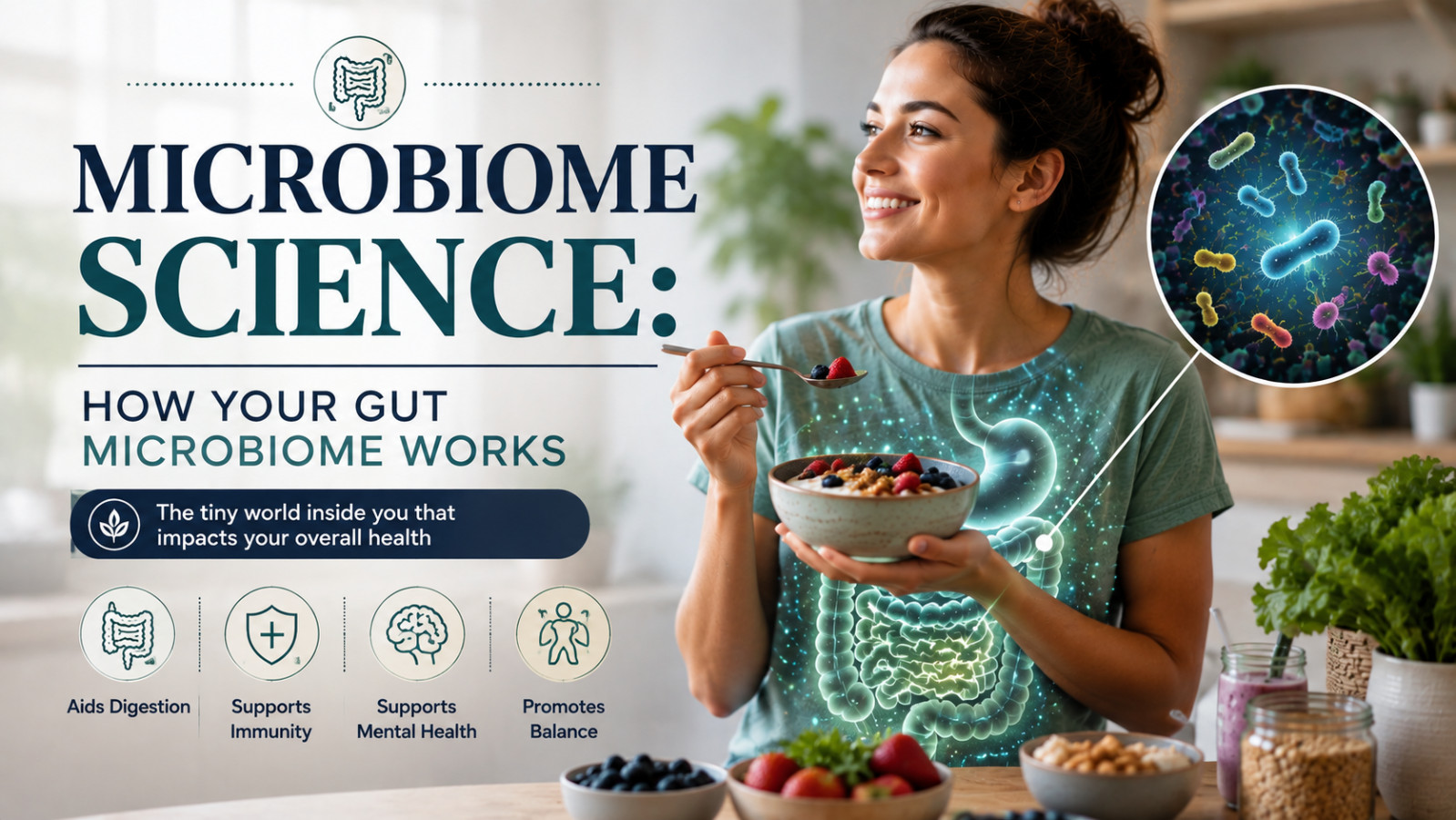
Microbiome science helps explain how the enormous community of microorganisms living in and on your body may influence everyday health. The subject can sound technical, yet many of its biggest ideas connect to familiar things, including food, digestion, sleep, and daily habits. You can use the Copy Button to save the key points from this guide and revisit them whenever you want.
Quick Answer: What Is Microbiome Science?
Microbiome science is the study of communities of microorganisms and their genetic material in a particular environment, including the human body. Gut microbiome research focuses on the bacteria and other microorganisms living in the digestive tract and how they interact with each other, food, and the body.
Researchers are still learning how these complex communities function. Therefore, microbiome science offers exciting insights, but it does not support the idea that one food, supplement, or test can explain everything about your health.
Microbiome Science Begins With a Simple Idea
The human body is home to many microorganisms. These include bacteria, fungi, viruses, and other tiny organisms that occupy different areas of the body.
The gut is one of the most widely studied microbial environments.
When people hear the word “bacteria,” they often think about infection. However, bacteria are not automatically harmful. Many bacterial species live alongside us as part of normal human biology.
Microbiome science examines this larger community.
Researchers want to understand which microorganisms are present, how they interact, and how changes in the environment may affect them. Food is part of that environment, although many other factors matter too.
It helps to picture the gut as a busy neighborhood rather than a single organism.
Different residents have different roles. Some interact with dietary compounds, while others may interact with neighboring microorganisms.
That complexity explains why scientists continue to study the microbiome.
What Does Microbiome Science Study?
Microbiome science covers much more than simply counting bacteria.
Researchers may study the types of microorganisms found in a sample. They can also examine genes, microbial activity, and chemical compounds connected to the microbial environment.
These approaches help scientists ask different questions.
For example, finding a microorganism tells researchers that it may be present. However, presence alone does not always explain what that microorganism is doing.
That distinction matters.
Two people can have different gut microbial communities and still be healthy. Similarly, a person may experience changes in the microbiome without immediately noticing digestive symptoms.
Scientists therefore look beyond simple lists.
They study relationships, functions, environmental influences, and possible connections with human health. As a result, microbiome research can become complicated very quickly.
For readers, the most useful takeaway is simpler: your gut contains a changing ecosystem, and researchers are still learning how all its pieces fit together.
How Microbiome Science Studies Gut Bacteria
Studying microorganisms isn’t always easy.
Many microbes are difficult to observe using older laboratory methods. Modern scientific techniques have given researchers more ways to examine microbial communities.
Scientists can analyze biological samples and identify genetic material associated with microorganisms. This can help them learn more about the kinds of microbes present in a particular environment.
However, technology has limitations.
A test may show that certain genetic material is present without providing a complete picture of how active a microorganism is. Therefore, researchers often need multiple methods to investigate a question.
Microbiome science also faces another challenge: people are different.
Diet, geography, age, medications, lifestyle, and many other factors can influence the microbial environment. That makes broad conclusions difficult.
I find this part especially useful to remember when reading headlines. A study can reveal an interesting connection, yet one finding rarely settles an entire scientific question.
Why the Gut Microbiome Gets So Much Attention
The digestive tract provides a fascinating environment for microorganisms.
Food regularly passes through it. Different nutrients and fibers can reach different parts of the digestive system, creating changing conditions for microbial communities.
The gut also plays an important role in digestion.
Because of this, researchers study how microorganisms interact with the digestive environment. Some gut microbes can interact with components of food that the human digestive system does not completely process in the same way.
Dietary fiber receives particular attention for this reason.
Certain fibers can reach the large intestine, where microorganisms may interact with them. Research continues to explore the products and processes involved.
However, gut microbiome research extends beyond fiber.
Scientists are also interested in microbial diversity, metabolism, immune interactions, medications, and many other topics. The field is broad, and new questions continue to emerge.
Microbiome Science and the Foods You Eat
Food can influence the environment inside the digestive tract.
That does not mean every meal instantly rebuilds your microbiome. Instead, your usual dietary pattern may be more meaningful than a single breakfast or snack.
Plant foods provide a useful example.
Fruits, vegetables, beans, whole grains, nuts, and seeds contain different types of fiber and naturally occurring compounds. Because these foods differ from one another, dietary variety can expose the gut environment to a wider range of food components.
Oats and lentils are different.
Blueberries and broccoli are different too.
Therefore, eating a varied diet may be more practical than searching for one perfect gut-health food.
Try rotating the foods you already enjoy.
Choose different fruits during the week. Add another type of bean to a soup. Switch between whole grains occasionally.
These changes don’t guarantee a particular microbiome result. Still, they can make your overall diet more varied and nutritionally balanced.
What Microbiome Science Says About Bacterial Diversity
Bacterial diversity refers to the variety of different bacteria in a microbial community.
Scientists often examine diversity when studying the gut microbiome. A more varied community may provide a broader range of microbial functions, although diversity alone does not determine whether a microbiome is healthy.
This point deserves emphasis.
More diversity is not a score that everyone needs to maximize.
Researchers also consider the specific microorganisms present and the functions they may perform. In addition, individual differences can make one person’s microbial community very different from another person’s.
Microbiome science is moving away from overly simple ideas about “good” and “bad” bacteria.
Context matters.
A microorganism may behave differently depending on its environment. Interactions between microbes can also influence what happens inside a complex microbial community.
For everyday eating, variety remains a sensible principle.
Instead of obsessing over microbial test results, most people can focus on building meals with a range of plant foods.
Microbiome Science and Fermented Foods
Fermented foods often appear in conversations about gut health.
Yogurt and kefir may contain live microorganisms, depending on the product. Other fermented foods can also contain microbes, although the type and amount may vary.
Still, fermented food and probiotic are not identical terms.
A probiotic has a specific scientific meaning. It refers to a live microorganism associated with a health benefit when consumed in an adequate amount.
Not every fermented food meets that definition.
That doesn’t make fermented foods unimportant.
They can simply be enjoyed as part of a varied diet. Plain yogurt with berries and oats, for example, offers a practical combination of familiar foods.
Meanwhile, kefir can work well in smoothies.
The best choice is usually one you genuinely enjoy and can include regularly. Forcing yourself to eat a food you dislike rarely creates a sustainable habit.
What Microbiome Science Cannot Tell Us Yet
Microbiome research has produced fascinating questions, but scientists still have plenty to learn.
One major challenge involves cause and effect.
Suppose researchers notice that people with a particular health characteristic often have differences in their microbial communities. That finding may show an association.
However, an association does not automatically prove that one factor caused the other.
The relationship could work in several directions.
Other lifestyle or biological factors may also influence both the microbiome and the health outcome being studied.
Therefore, headlines can sometimes sound more certain than the science behind them.
Be cautious when you see claims that scientists have found the “perfect” gut bacteria or discovered one simple way to fix the microbiome.
The real science is usually more interesting and more complicated.
How Lifestyle May Affect the Gut Microbiome
Food isn’t the only part of the story.
Medication use can influence microbial communities. Age and daily routines may also play a role.
Researchers are interested in the possible relationships between physical activity, sleep, stress, and the microbiome as well.
However, no one needs a perfect lifestyle.
A stressful week doesn’t permanently destroy your gut microbiome. Similarly, one night of poor sleep doesn’t erase the value of your regular habits.
Consistency is more useful than perfection.
Try to build a routine that supports your general well-being. Eat balanced meals, move regularly, and make sleep a priority when possible.
These habits support health beyond the microbiome.
That broader perspective can prevent gut health from becoming another source of unnecessary pressure.
Can Microbiome Science Explain Digestive Problems?
Not by itself.
The gut microbiome may be relevant to many areas of digestive research, but digestive symptoms can have many possible causes.
Bloating, constipation, diarrhea, and abdominal discomfort do not automatically mean someone has a “bad microbiome.”
Food choices, meal size, hydration, medications, and other factors can contribute to digestive changes.
Sometimes the explanation is simple.
For instance, rapidly increasing fiber intake can leave some people feeling gassy or bloated. A gradual increase may feel more comfortable.
That is why context matters.
Microbiome science can help researchers understand biological processes. However, it should not encourage people to diagnose themselves based on social media posts or microbiome marketing.
Microbiome Science and Personalized Testing
Personalized microbiome testing has become a growing area of consumer interest.
These tests generally examine a sample to provide information about microorganisms or genetic material associated with the gut.
The reports can look impressive.
However, interpretation is challenging.
Scientists are still working to understand what many individual differences in microbiome composition mean for a specific person’s health. Therefore, a colorful chart showing different bacteria does not automatically tell you which foods you must eat.
Be especially cautious with recommendations that promise to create a perfect microbiome.
Your gut ecosystem naturally changes over time.
A test result may offer interesting information, but it is not necessarily a complete picture of your digestive health. The science is still developing, and meaningful interpretation requires context.
Practical Lessons From Microbiome Science
You don’t need a laboratory to apply some of the broader lessons from microbiome research.
Start with the basics.
Eat a Wider Variety of Plant Foods
Rotate fruits, vegetables, beans, whole grains, nuts, and seeds.
Different foods bring different nutrients and fibers to your plate.
Increase Fiber Gradually
If you currently eat little fiber, avoid making dramatic changes overnight.
Instead, add high-fiber foods step by step.
Include Foods You Actually Enjoy
A healthy eating pattern works best when it fits your preferences.
Yogurt, beans, berries, oats, leafy greens, and nuts can all be useful choices.
Avoid Chasing Miracle Products
No supplement can replace the value of a generally balanced diet.
Look past dramatic promises and complicated marketing.
Think in Weeks, Not Single Meals
Your regular habits matter more than one imperfect dinner.
That perspective can make healthy eating feel much less stressful.
A Realistic Day Inspired by Microbiome Research
Breakfast could be oatmeal topped with blueberries, walnuts, and chia seeds.
For lunch, you might enjoy a grain bowl with chickpeas, mixed greens, tomatoes, and roasted vegetables.
Dinner could include your preferred protein alongside broccoli and sweet potatoes.
A snack of yogurt and fruit could add even more variety.
This isn’t a prescription.
Instead, it shows how ordinary foods can create a diverse menu without requiring expensive products or complicated recipes.
The following day can look completely different. In fact, changing your menu is part of the point.
Frequently Asked Questions About Microbiome Science
What is microbiome science?
Microbiome science studies communities of microorganisms and their genetic material. It includes research into the gut microbiome and how microbes interact with their environment.
What does the gut microbiome do?
The gut microbiome is a complex community of microorganisms that interacts with the digestive environment, food components, and other microorganisms.
Can diet change the gut microbiome?
Diet can influence the gut environment. Long-term dietary patterns and food variety may matter more than any single meal.
Is microbiome testing useful?
Microbiome testing can provide information about microorganisms in a sample. However, scientists are still learning how to interpret many individual differences.
Can I improve my microbiome naturally?
A practical approach includes eating a varied diet with plenty of plant foods and maintaining healthy daily habits. No single food can guarantee a specific microbiome result.
The Future of Microbiome Science
Microbiome science is still evolving, which makes it one of the most interesting areas of modern health research.
Scientists continue to investigate how microorganisms interact with food, each other, and the human body. New methods may help researchers answer questions that remain difficult today.
At the same time, curiosity should not turn into exaggerated promises.
Microbiome science gives us a better reason to appreciate the complexity of the gut, not a reason to believe that one product can control it.
For most people, the practical message remains refreshingly simple. Eat a varied range of nutritious foods, especially plant foods, make gradual changes, and avoid treating your microbiome like a problem that needs constant fixing.
Use the Copy Button to save this guide on microbiome science, then come back whenever you want a clear reminder of what researchers know, what they are still studying, and what you can realistically do for your gut.

Elizabeth Boham is a respected functional medicine physician and wellness educator with a passion for helping people improve their health through nutrition and lifestyle changes. As a contributor to Gutrova, she shares practical insights on gut health, digestive wellness, and healthy living, making complex health topics easy to understand and apply in everyday life.











1 thought on “Microbiome Science: How Your Gut Microbiome Works”