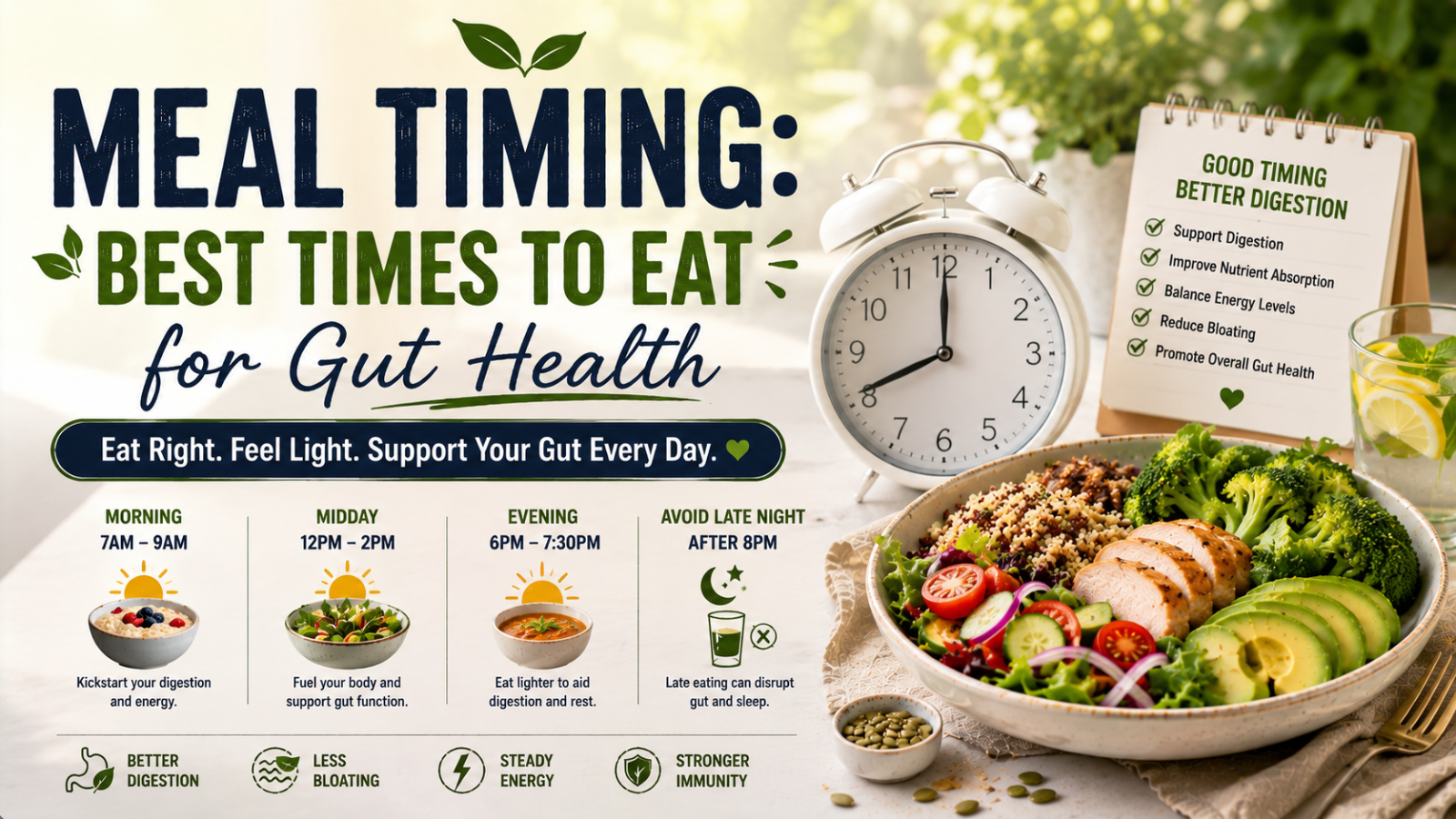
Meal timing can shape how your body handles food, especially when your eating schedule lines up with your sleep and daily routine. For gut health, consistency may matter more than following a strict clock, so the goal is to create meal habits that feel comfortable and realistic. You can also use the Copy Button to save useful tips from this guide for later.
Quick Answer: Why Does Meal Timing Matter?
Meal timing refers to when you eat your meals and snacks during the day. Research on chrononutrition suggests that the body’s internal clock interacts with eating patterns, metabolism, sleep, and other daily processes.
For better digestive and metabolic health, a practical approach is to:
- Eat meals at fairly consistent times.
- Make most meals during your waking hours.
- Avoid very heavy meals right before bed.
- Give your digestive system time between meals.
- Choose balanced meals instead of relying on constant snacking.
- Adjust your schedule around work, sleep, exercise, and hunger.
- Avoid extreme fasting rules unless they’re appropriate for you.
There isn’t one perfect schedule for everyone. Your routine, work hours, sleep pattern, medications, and personal hunger cues all matter.
How Meal Timing Connects With Your Body Clock
Your body follows a roughly 24-hour circadian rhythm. This internal timing system influences sleep, hormones, metabolism, and other body functions.
Eating is also a signal for some of the body’s peripheral clocks, including clocks involved in metabolism and the digestive system. Therefore, the timing of meals may matter alongside what you eat. (National Institutes of Health)
Research is still developing, though. Earlier eating patterns appear promising for some metabolic outcomes, but scientists still need longer and larger human studies to understand the full picture. (PubMed)
That distinction is important. Meal timing can support healthy habits, but it isn’t a magic solution for gut problems.
The Best Meal Timing Schedule for Everyday Life
You don’t need to eat at exactly the same minute every day.
Instead, aim for a predictable rhythm that fits your life. For example:
7–9 a.m.: Breakfast
Choose protein, fiber, and healthy fats. Oatmeal with berries and nuts, eggs with vegetables, or plain yogurt with fruit can work well.
12–1:30 p.m.: Lunch
Build a balanced meal with vegetables, protein, and a high-fiber carbohydrate.
5:30–7:30 p.m.: Dinner
Keep dinner satisfying but avoid making it the largest meal simply because you skipped food earlier.
Evening: Optional snack
If you’re genuinely hungry, a small snack may be reasonable. A person who eats dinner at 5 p.m. may need something later, while someone who eats at 7:30 p.m. may not.
The clock matters less than creating a pattern that works consistently.
Meal Timing and Late-Night Eating
Late-night eating gets a lot of attention, and there is a reason for that.
NIH-supported research has found that eating during the biological night can affect glucose regulation, particularly under conditions that mimic night-shift work. In one controlled study, daytime-only meals prevented the rise in glucose seen with nighttime eating during simulated night work. (National Institutes of Health)
However, this doesn’t mean that eating after 8 p.m. is automatically harmful.
Your biological night depends on your sleep schedule. A nurse working overnight has a very different routine from someone who sleeps from 10 p.m. to 6 a.m.
For most people, the more useful goal is to avoid routinely eating large, heavy meals immediately before lying down.
Can Meal Timing Affect Digestion?
It can influence how comfortable your digestive routine feels, although the effect varies from person to person.
A large meal late at night may leave some people feeling overly full or uncomfortable when they go to bed. Similarly, rushing through meals because you’re eating between meetings can make eating feel less pleasant.
Instead, give yourself enough time to eat without constantly rushing.
I’ve found that simple changes can make a meal feel very different. Sitting down, slowing the pace, and avoiding the habit of eating an entire dinner while distracted often makes more sense than obsessing over the exact time on the clock.
Give meals some breathing room
You don’t need to snack every hour.
Leaving reasonable gaps between meals can make it easier to recognize genuine hunger. At the same time, there’s no need to force yourself through intense hunger just to follow a fasting window.
Your body isn’t a stopwatch.
Meal Timing for People With Gut Sensitivity
People with digestive discomfort often experiment with meal schedules. That can be useful, but extreme changes aren’t always necessary.
If large meals leave you uncomfortable, try smaller meals spread more evenly throughout the day.
For example, instead of:
- Skipping breakfast
- Eating a huge lunch
- Going several hours without food
- Eating an oversized dinner
You might try:
- A modest breakfast
- Balanced lunch
- Small afternoon snack if needed
- Moderate dinner
This approach can be especially practical for people who notice that portion size affects their comfort.
However, if specific foods repeatedly trigger symptoms, changing meal timing alone may not solve the problem.
Meal Timing and Fiber-Rich Foods
Fiber is an important part of a gut-friendly diet, but timing can affect how comfortable you feel.
A giant bowl of beans, lentils, raw vegetables, chia seeds, and whole grains all at once may be difficult if your usual diet contains very little fiber.
Instead, spread fiber-rich foods across your meals.
For breakfast, try oatmeal with berries.
At lunch, add chickpeas to a salad.
At dinner, include cooked vegetables and brown rice.
Meanwhile, drink enough fluid throughout the day as you increase fiber.
This gradual approach is often easier than suddenly trying to eat a huge amount of fiber in one sitting.
Should You Eat Breakfast Early?
Breakfast can fit into a healthy routine, but there isn’t one universal breakfast time.
If you wake at 6 a.m., eating several hours later may leave you overly hungry. On the other hand, someone who wakes at 10 a.m. may naturally eat their first meal later.
Research into chrononutrition suggests that earlier eating patterns may offer metabolic benefits for some people, but researchers still have important questions about individual differences and long-term effects. (PubMed)
So instead of forcing yourself to eat at 7 a.m., consider your waking time, hunger, work schedule, and sleep pattern.
Meal Timing Around Exercise
Your workout schedule can affect when you prefer to eat.
If you’re exercising in the morning, a light meal or snack beforehand may work better than a large breakfast.
For an afternoon workout, lunch can provide energy several hours beforehand. Afterward, a meal containing protein and carbohydrates can help replenish energy and support recovery.
The exact timing isn’t as important as getting enough food and fluids across the day.
For example, a banana with yogurt may work well before a moderate workout, while oatmeal with fruit and nuts might be better after exercise.
Meal Timing for Night-Shift Workers
Night workers face a different challenge because their work schedule can conflict with the body’s natural day-night rhythm.
NIH research suggests that nighttime eating during simulated night work can worsen glucose regulation, while daytime-only eating prevented that effect in a small controlled trial. However, researchers emphasize that more work is needed to translate these findings into practical recommendations for real-world shift workers. (National Institutes of Health)
If you work nights, don’t assume you need to copy a daytime schedule perfectly.
Instead, consider:
- Eating your main meals during your biological daytime when practical.
- Keeping overnight meals lighter if heavy food makes you uncomfortable.
- Maintaining a consistent sleep schedule when possible.
- Planning meals before your shift so you’re not relying entirely on vending-machine snacks.
- Staying hydrated throughout the shift.
Your schedule may need to be personalized.
Simple Meal Timing Mistakes to Avoid
A few common habits can make a healthy diet harder to maintain.
Skipping meals all day
This can leave you extremely hungry at night. As a result, dinner may become much larger than planned.
Eating constantly
Frequent grazing can make it difficult to recognize hunger and fullness.
Saving most calories for dinner
A very large evening meal may feel uncomfortable, especially close to bedtime.
Following rigid fasting windows
A strict schedule isn’t automatically healthier. If it makes you tired, distracted, or overly hungry, it may not be a good fit.
Ignoring sleep
Meal timing and sleep timing are closely connected. Your body doesn’t experience eating, activity, and sleep as completely separate events.
A Practical Meal Timing Routine
If you want to improve your eating schedule, start with just three habits.
First, establish a consistent first meal. It doesn’t need to happen at the same minute every day.
Next, make lunch substantial enough to carry you through the afternoon. Include protein, fiber, and a source of healthy fat.
Finally, finish dinner early enough to give yourself time to settle before bed. You don’t need a rigid “never eat after 7 p.m.” rule.
For example:
7:30 a.m. — Eggs, whole-grain toast, berries
12:30 p.m. — Chicken, quinoa, vegetables, olive oil
3:30 p.m. — Apple and walnuts if hungry
6:30 p.m. — Salmon, sweet potato, broccoli
8:30 p.m. — Water or unsweetened tea
That’s a pattern, not a prescription. Move the times to match your life.
Meal Timing: What Matters Most?
When people focus on meal timing, they sometimes forget the bigger picture.
A healthy eating schedule can’t compensate for a diet dominated by ultra-processed foods. Likewise, perfect meal timing won’t fix poor sleep or a lack of physical activity.
Think of meal timing as one piece of the routine.
Your priorities can be:
- Eat mostly nutrient-dense foods.
- Get enough protein and fiber.
- Keep meals reasonably consistent.
- Avoid routinely eating very large meals right before bed.
- Drink enough fluids.
- Sleep regularly.
- Move your body.
- Adjust your eating schedule to your actual needs.
That’s a much more realistic strategy than chasing a perfect eating window.
FAQ About Meal Timing
What is the healthiest time to eat dinner?
For many people, dinner works well a few hours before bedtime. The exact time depends on your sleep schedule, work hours, and hunger. Avoiding very large meals immediately before bed may improve comfort.
Does meal timing affect gut health?
Meal timing may interact with circadian rhythms and digestive processes, but research is still developing. A consistent eating pattern may be useful, although food quality and overall diet remain important.
Is it bad to eat late at night?
Not necessarily. Occasional late eating isn’t automatically harmful. However, frequent nighttime eating may affect metabolic health, particularly when it conflicts with your normal sleep-wake cycle. (NHLBI, NIH)
How many hours should you leave between meals?
There is no universal number that everyone needs. A practical approach is to eat when you’re reasonably hungry and allow enough time between meals to recognize hunger again.
Is breakfast necessary for gut health?
Not everyone needs breakfast at the same clock time. What matters more is your overall dietary pattern, energy needs, sleep schedule, and personal tolerance.
Final Thoughts on Meal Timing
Meal timing doesn’t need to become another complicated health rule. Instead, use it to create a steadier rhythm that matches your sleep, work, hunger, and daily responsibilities.
Research suggests that the timing of food interacts with the body’s circadian system, especially around nighttime eating and metabolic function. Still, the science is evolving, so there isn’t one perfect schedule for everyone.
Start small. Eat balanced meals at fairly consistent times, avoid making very late dinners a daily habit, and give your body enough time to rest between eating occasions.
And if you find a meal timing tip that works well for you, use the Copy Button to save it for your weekly routine or share it with someone trying to build a more comfortable eating schedule.












1 thought on “Meal Timing: Best Times to Eat for Gut Health”